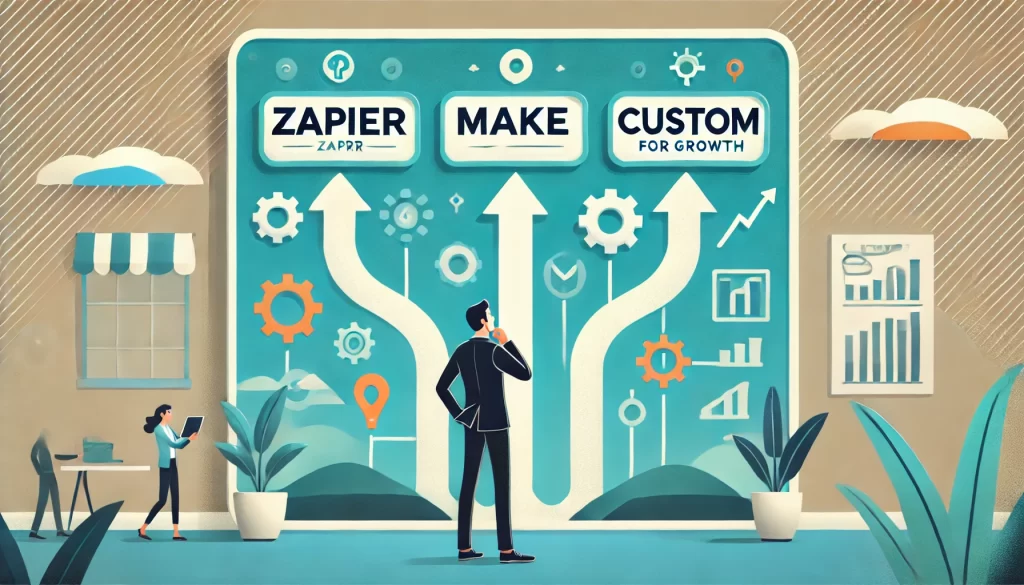
Every entrepreneur hits the same wall. You’re drowning in repetitive tasks—copying data between tools, sending the same emails, updating spreadsheets—and you realize: “This should be automated.” But then comes the real question: do you plug into an off-the-shelf tool like Zapier, go deeper with Make, or invest in building something custom? Each path has trade-offs.
Every entrepreneur hits the same wall. You’re drowning in repetitive tasks—copying data between tools, sending the same emails, updating spreadsheets—and you realize: “This should be automated.”
But then comes the real question: do you plug into an off-the-shelf tool like Zapier, go deeper with Make, or invest in building something custom? Each path has trade-offs. Choose wrong, and you’ll either waste money on overkill or stall growth by relying on duct tape.
The truth is, there’s no one-size-fits-all. The right automation depends on your stage, your complexity, and your growth goals. Here’s how to think about it.
Zapier: Simple, Fast, Plug-and-Play ⚡
Zapier is for quick wins. It’s easy, visual, and beginner-friendly. You can connect apps in minutes without touching code. Perfect if you’re a solopreneur or small team wanting to automate lead captures, notifications, or basic workflows.
The upside is speed. You can automate today, not next quarter. The downside is limits—Zapier starts to feel clunky (and expensive) once you’re running complex, high-volume processes.
Best for:
- 👩💻 Solopreneurs who need fast wins without coding
- 👥 Small teams that want to save time on repetitive admin
- 🚀 Early-stage founders testing processes before scaling
Make: Flexibility Without the Full Dev Team 🔄
Make (formerly Integromat) is the middle ground. It’s more flexible than Zapier, letting you build multi-step workflows with logic, filters, and branching. If Zapier is duct tape, Make feels more like a toolkit.
It takes a bit more effort to learn, but it pays off if you’re scaling and need workflows that adapt to more complex operations. It’s also more cost-effective at volume compared to Zapier.
Best for:
- 📈 Growth-stage businesses scaling past Zapier’s limits
- 🏢 Agencies that manage complex, multi-client processes
- 🔧 Teams needing advanced workflows without hiring developers
Custom Automation: Power, Scale, and Ownership 🛠️
Custom automation is for when you’re playing big. Instead of renting someone else’s platform, you build your own systems—scripts, APIs, and integrations designed exactly for your business.
The payoff is scalability and full control. No platform limits. No runaway subscription costs. But the trade-off is investment—you need developers to build and maintain it. For early-stage founders, it’s overkill. For established companies, it’s the only way to scale reliably.
Best for:
- 🏭 Established companies running thousands of daily tasks
- 📊 Enterprises needing mission-critical performance and reliability
- 🔒 Businesses that want full control and ownership of their systems
How to Choose the Right Path 🎯
1️⃣ Starting out? → Zapier.
If you’re early-stage, speed matters more than perfection. Use Zapier to automate small, repetitive tasks fast and free up time without overcomplicating things.
2️⃣ Scaling? → Make.
As processes get more complex, Zapier starts to break. Make gives you flexibility—multi-step workflows, logic, and cost efficiency—without needing a full dev team.
3️⃣ Operating at scale? → Custom.
Once you’re running thousands of processes daily, off-the-shelf tools hit their limits. Custom automation gives you control, performance, and long-term savings—but requires real investment.
🔑 Rule of thumb: start lean, upgrade as your complexity grows, and only go custom when scale demands it.
Final Thought ⚡
Automation isn’t about being fancy. It’s about leverage. Zapier, Make, and custom builds are all tools in the same toolbox—you just need to know when to grab which one.
If you’re small, keep it simple. If you’re growing, stop patching things with duct tape. And if you’re scaling big, stop renting and start owning.
🔑 The real win isn’t automating everything—it’s automating the right things, with the right tool, at the right stage of growth.
Author