Most entrepreneurs are about to lose—not because their products are bad, not because they’re lazy, but because they’re fighting the wrong battle. They’re trying to out-hustle people who have machines doing the work for them. It’s like showing up to a Formula 1 race on a bicycle. Here’s the truth: in 2025, AI isn’t optional.
Most entrepreneurs are about to lose—not because their products are bad, not because they’re lazy, but because they’re fighting the wrong battle. They’re trying to out-hustle people who have machines doing the work for them. It’s like showing up to a Formula 1 race on a bicycle.
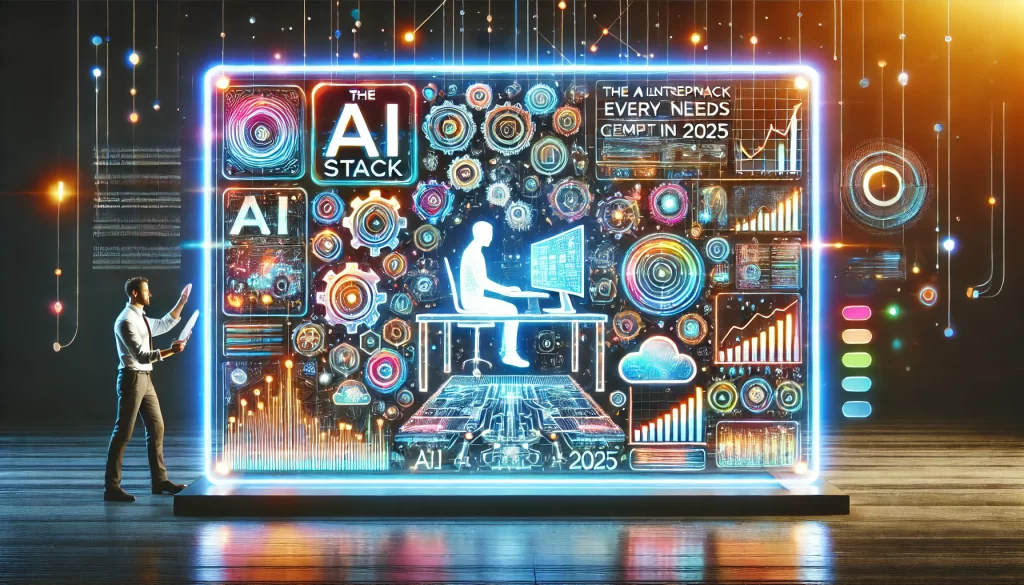
Here’s the truth: in 2025, AI isn’t optional. It’s not a “nice-to-have.” It’s survival. The businesses that win aren’t the ones working harder. They’re the ones working smarter, stacking AI across their business so it compounds output, slashes costs, and removes bottlenecks.
The question isn’t “Should I use AI?” The question is: “How do I build an AI stack that gives me an unfair advantage?”
Let’s break it down layer by layer.
1. Marketing & Content: Multiply Output, Not Effort ✍️📱
Attention is the currency of business. Without it, you’re invisible. But most entrepreneurs are still treating content like it’s 2015: manually writing every post, stressing over perfect copy, and burning hours on one piece of content that barely gets traction.
AI flips that game. Instead of spending days creating, you spend minutes. You turn one idea into 10 variations. You adapt it across platforms in the time it used to take to write a single draft. The leverage is insane.
Here’s the practical move:
- Start with one core idea (your framework, your process, your client win).
- Use AI to brainstorm angles and spin-offs.
- Repurpose across formats—short text, long form, video scripts.
- Ship volume.
You’re not replacing creativity—you’re multiplying its reach. In 2025, the entrepreneur who can consistently flood the market with smart, relevant content will always win more attention than the one who posts once a week.
2. Sales & Lead Generation: Automate the Hunt 💼🎯
Sales is simple: talk to more qualified people, close more deals. The problem? Most of your time gets wasted finding, filtering, and chasing. The human brain wasn’t built to process thousands of potential leads efficiently.
AI doesn’t just help—it eliminates the grind. Imagine every morning you wake up to a short list of leads already ranked by likelihood to buy, complete with context and insights. Your job isn’t digging through databases anymore. Your job is showing up to the conversations that matter.
Practical move:
- Define your ideal client clearly.
- Automate the repetitive steps that waste time (research, qualification, follow-up sequences).
- Focus your energy only on real buyers.
Instead of spending 80% of your time prospecting and 20% selling, AI flips the ratio. Now you spend 80% selling and 20% reviewing.
3. Customer Experience: Be “Always-On” Without Burning Out 🤝⚡
Your customers don’t care about your schedule. They don’t care if it’s 2 a.m., if you’re on vacation, or if you’re slammed with other work. They expect answers now.
Traditionally, the only way to keep up was to throw people at the problem—hire more reps, build bigger support teams, expand hours. But people don’t scale infinitely. Payroll grows, margins shrink, and service still suffers.
AI gives you a different option. It handles repetitive questions instantly, directs people to resources, and only escalates to humans when necessary. That means faster service for the customer, less pressure on your team, and a system that feels “always-on” without adding headcount.
Practical move:
- List the top 20 most common customer questions or issues.
- Create AI-powered responses for them.
- Train your team to step in only when something falls outside the system.
You don’t need to replace humans—you need to free them to handle what matters most.
4. Operations: Kill the Busywork 📊🛠️
Most entrepreneurs confuse “being busy” with “being productive.” The truth? The majority of the work that fills your calendar is low-value admin. Reports, scheduling, bookkeeping, follow-ups. None of that grows the business. It just keeps the machine running.
AI turns this overhead into background noise. It tracks, organizes, summarizes, and schedules without you touching it. Instead of spending hours each week doing things you hate, you free that energy for growth.
Practical move:
- At the end of the week, write down 5 things that drained your time but didn’t grow revenue.
- Ask: “Can this be automated?”
- Replace one every month until your calendar is filled only with high-leverage work.
This isn’t just efficiency. It’s sanity.
5. Strategy & Decisions: See What Others Can’t 🧠🔮
The final layer of the stack isn’t speed—it’s clarity. Entrepreneurs fail not because they work too little, but because they make bad decisions with incomplete data. They rely on gut feelings while competitors are running simulations and spotting trends weeks earlier.
AI doesn’t just crunch numbers—it identifies patterns, predicts outcomes, and points out what you’re missing. It’s like moving from checkers to chess. Suddenly, you’re not just reacting to the present—you’re planning three moves ahead.
Practical move:
- Use AI to analyze key drivers: where your revenue comes from, where customers drop off, where costs are bloated.
- Run “what if” scenarios before making big moves.
- Make decisions backed by patterns, not just feelings.
The entrepreneur who makes decisions with clarity will always beat the one guessing in the dark.
How to Build Your AI Stack Without Drowning 🧩
This is where most people screw up. They binge on tools. They chase shiny objects. They sign up for 12 subscriptions and use none of them properly. The graveyard of half-used tech kills more momentum than it creates.
Here’s the smarter way:
- Start small. Pick one layer of the stack (content, sales, service, ops, or strategy).
- Automate one bottleneck at a time. Don’t touch the next until the first is running smoothly.
- Connect your stack. Make sure information flows across systems. A broken stack is just noise.
- Expand slowly. The best stacks grow like scaffolding: one strong layer at a time.
Your AI stack should feel invisible. Like a machine humming in the background, multiplying your output without demanding your attention.
Final Word ⚡
AI isn’t here to replace you. It’s here to replace inefficiency. The entrepreneurs who win in 2025 won’t have the biggest teams or the fanciest offices. They’ll have the leanest, smartest systems. Businesses that look small on the outside but operate like giants on the inside.
The question isn’t “Should I be using AI?” The question is: “How much longer can I afford to compete against people who already are?”
👉 Build your stack now. Or watch someone else outwork you—not because they’re smarter or hungrier, but because they’ve got machines doing the heavy lifting while you’re still trying to pedal uphill.
Author